
If you enjoyed reading both my novels set during the German Occupation of Guernsey, and the Liberation, you’ll be interested to hear I’m busy writing a third novel in the series! This novel picks up the story of Ellen and Lukasz, Lucy and all the background to their lives as the island desperately tries to get back on its feet after the damage and heartache caused by the war. What happens in the years that follow, when the aftermath of severe rationing, enemy occupation, curfew and families being split apart starts to take effect?
My new novel will begin in the autumn and winter of 1946. In England, people are still suffering as food and fuel are scarce, houses have bomb damage, finding employment is difficult. In France and across Europe, the story is worse. Islanders eager to restore Guernsey to how it was before the Germans invaded, have a huge task on their hands. However, so many houses and buildings have either been damaged or demolished altogether that the returning evacuees sometimes discovered they had nowhere left to live. Promises had been broken, and property that they believed would be protected were often broken into – their contents stolen or burnt. So while rejoicing that WWII was over, it was far from being returned to the paradise island it was before …
So watch this space for more news!
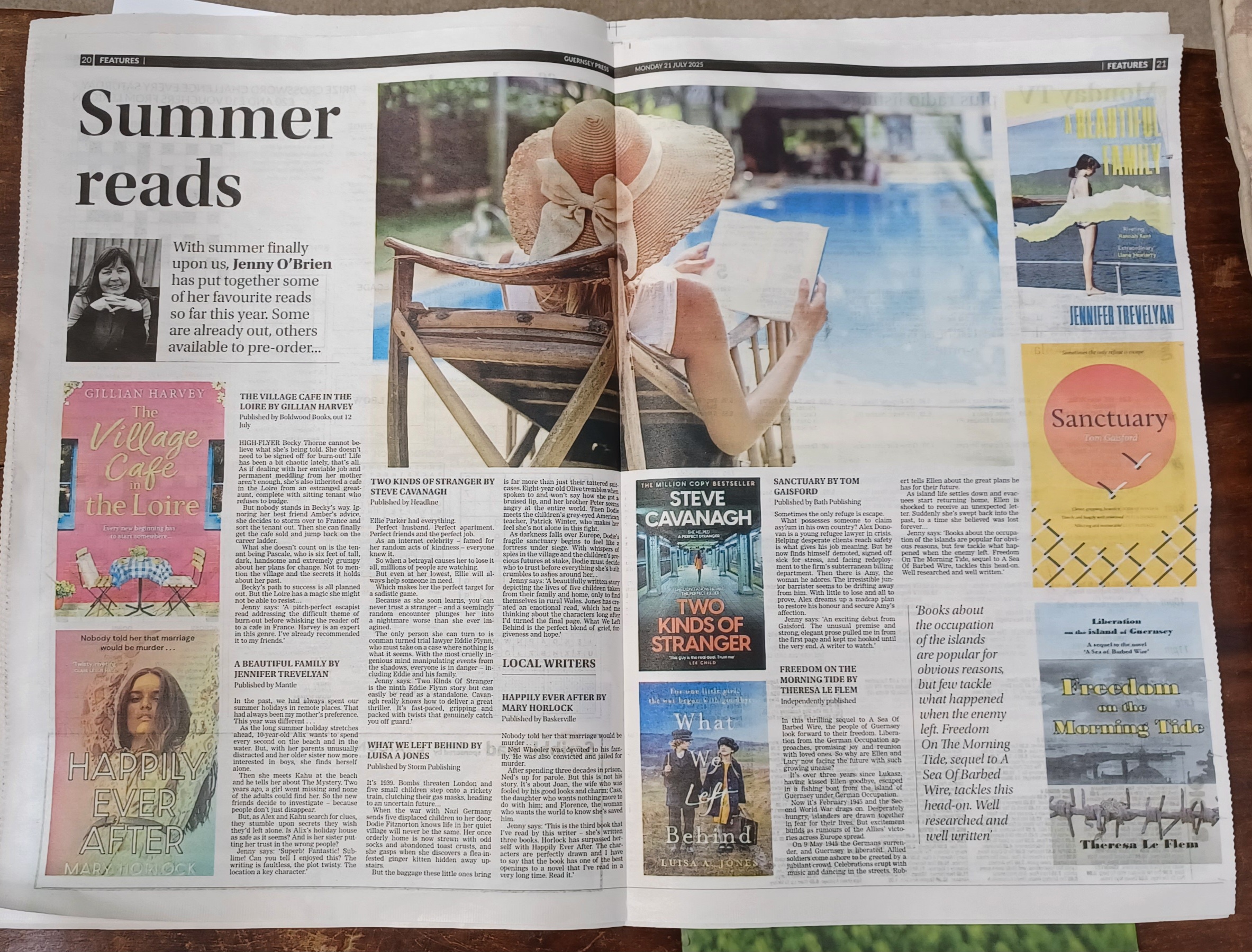
A fabulous surprise to see my latest book among the recommended Summer Reads in the Guernsey Press on Monday. Many thanks to Jenny O’ Brien for giving Freedom on the Morning Tide this honour.
I was honoured to present my latest novel for the Guernsey Literary Festival Local Voices event on 28th April. Appearing on stage with me was Kelvin Whelan, Guernsey Historian and proprietor of the Independent bookshop Writer’s Block. We were with Nick Le Messurier who presented the talk and asked the questions. It was a great evening, great atmosphere and brilliant audience.
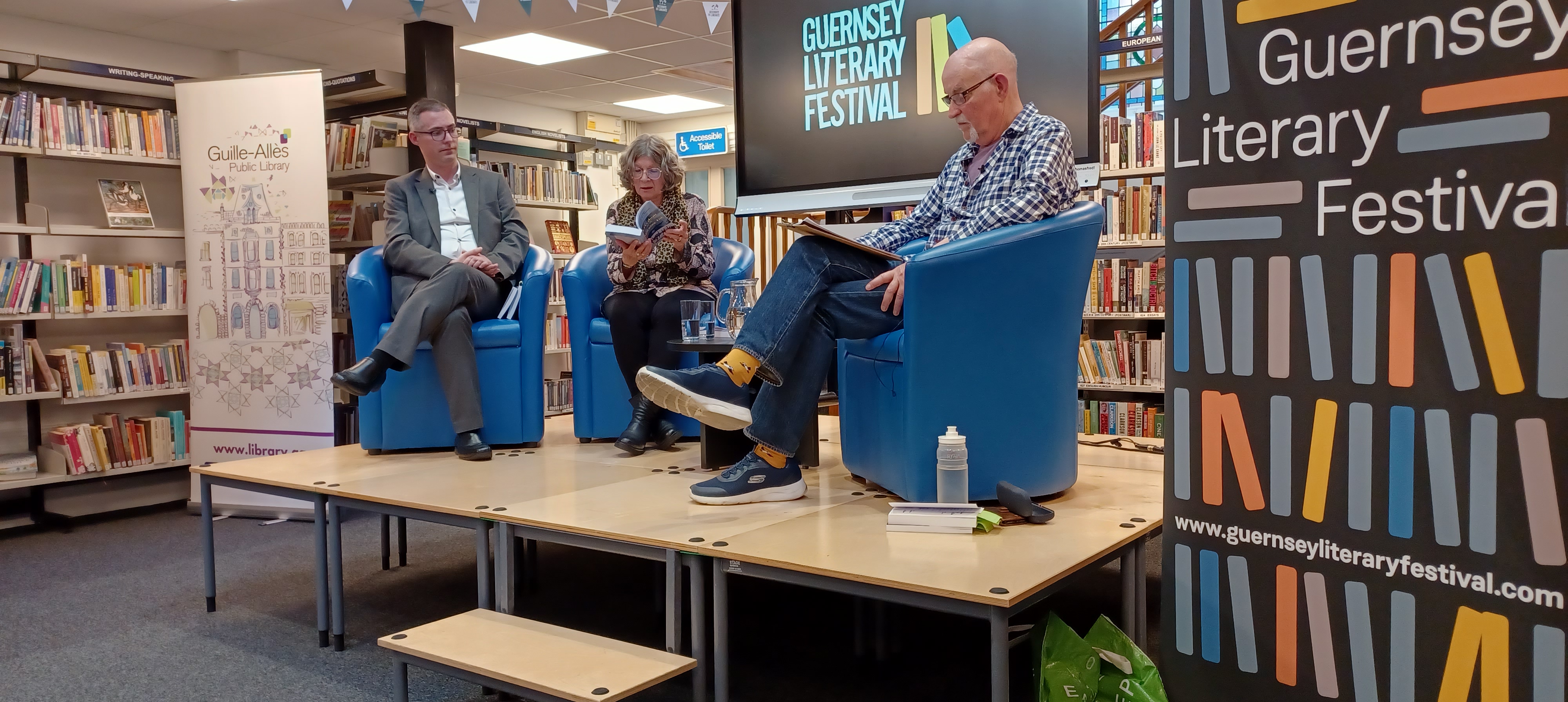
Freedom on the Morning Tide: Liberation on the island of Guernsey for the Guernsey Literary Festival. https://guernseyliteraryfestival.com/
If you’ve been reading A Sea of Barbed Wire: Fear, Romance and Betrayal in Occupied Guernsey you’ll be pleased to hear that this novel picks up the story of what happens to Ellen and all the characters whose lives were all affected by the war. You may also wonder what became of Lukasz after his attempt to escape from the island under the German oppression. It’s all revealed in this new book!
My book launch day turned out to be bright and sunny and I sold plenty of books, some even bought both to catch up! Thanks to proprietor Kelvin Whelan of Writer’s Block, Guernsey, for hosting it. Freedom on the Morning Tide will feature in Guernsey Literary Festival when I shall be talking about the novel and how I translated real life events into fiction. Being a historical novelist, all my novels have their origin rooted in the past.

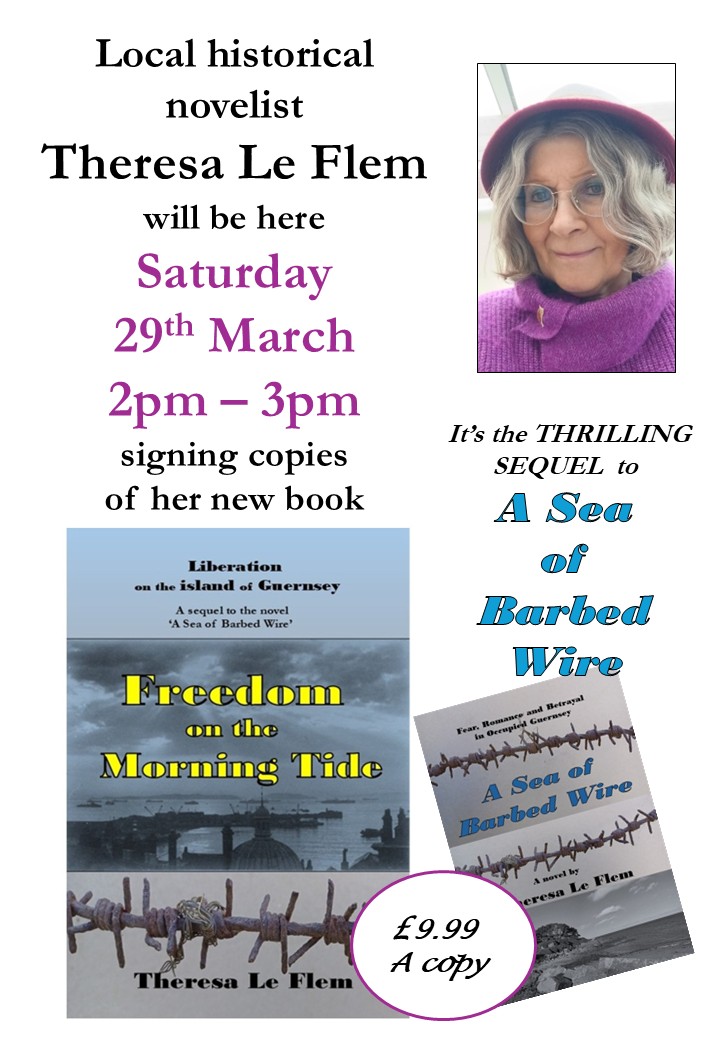
BOOK SIGNING
On Saturday 29th march 2pm -3pm I will be launching my new historical novel, signing books and answering questions at the Writer’s Block, the independent bookshop in St. Peter Port, Guernsey. Please join me if you can!
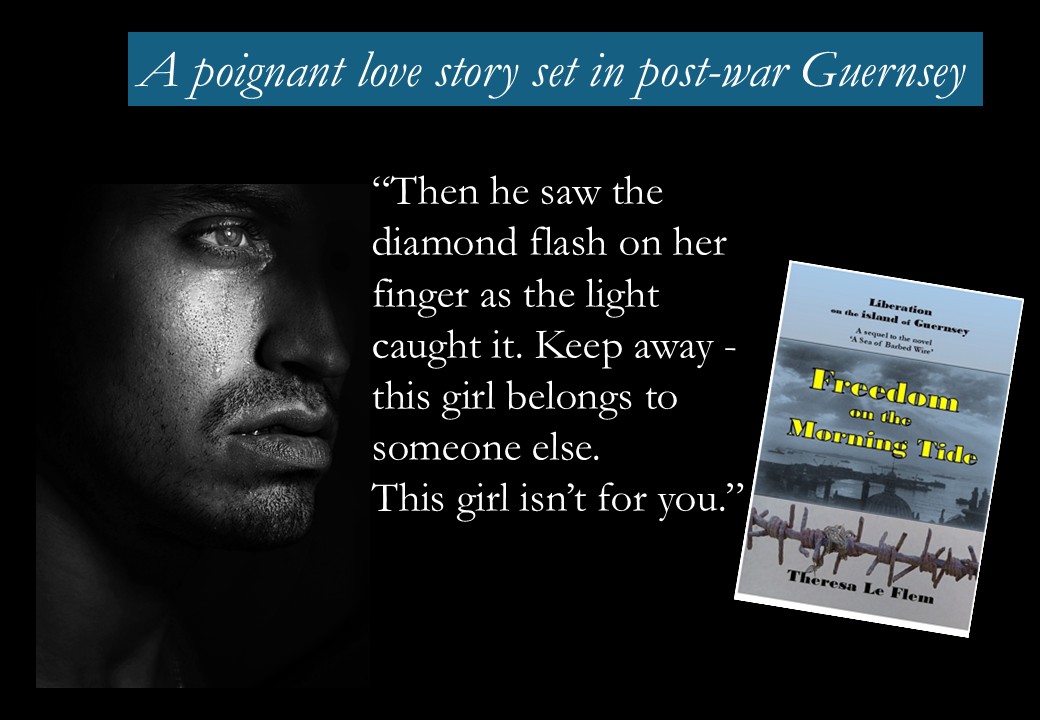
I’m proud to announce that my latest novel: Freedom on the Morning Tide: Liberation on the Island of Guernsey is available now on Amazon in paperback and as an ebook.
Guernsey Literary Festival https://guernseyliteraryfestival.com/
Freedom on the Morning Tide
I’m delighted to have been invited to talk about my new novel Freedom on the Morning Tide at the Guernsey Literary Festival 2025 . This is the sequel to A Sea of Barbed Wire, the novel set in 1942 during the time of The German occupation in WWII. This book takes up the story of Ellen and the islanders of Guernsey in the spring of 1945 when people were becoming desperate for food. The good ship, the SS VEGA chartered by the Red Cross, sails into St. Peter Port carrying life saving supplies. The situation on the island is dire, but for two friends, obtaining enough food to live on isn’t the only problem they have. When Liberation Day finally arrives bringing joy and freedom to islanders, why are Ellen and Lucy facing the future with growing unease? There are difficult choices to make, and freedom for some brings its own heartache. Nothing is quite the same on the island, five years on from the German invasion. What will the future hold for Ellen?
Freedom on the Morning Tide takes us up to Liberation Day 9th May 1945 and beyond.
Liberation Day
This year on 9th May 2025 we celebrate the 80th Anniversary of the Liberation in Guernsey. Liberation of the island could go two ways. Either the Germans would submit to pressure and surrender peacefully, or they would dig their heels in and fight. Rumours spread rapidly of the Allies victory across Europe. The German army were defeated and their ability to hold on to power was hopeless, but a hardline Nazi in Guernsey wasn’t going to back down. If you are following the story you will realise that from a personal point of view, the characters you will have grown to love find themselves in a traumatic situation. When the island is ready to enjoy their new found freedom, why are Ellen and Lucy looking towards the future with increasing alarm?
Evacuees returning to Guernsey
Imagine having to make the decision, with no more than 24 hours notice, whether to send your little children away to England for their own protection as the anticipated invasion of the enemy loomed. What would you do?
While those children who were evacuated often lost contact with their parents and knew nothing of their fate, those children who stayed might remember the desperate shortage of food, fresh fruit, clothes and the lack of any shoes to wear. They might also remember, ironically, the kindness of some German soldiers who gave them sweets and rushed to protect them when RAF planes flew low overhead. So what was it like when children separated from their mothers and and fathers for five years began arriving home?

There’s still time to read A Sea of Barbed Wire: Fear, Romance and Betrayal in Occupied Guernsey. The paperback is for sale in Guernsey at The Writer’s Block, The Lexicon, The Information Bureau and Candie Museum Gift Shop, at only £8.99.
It’s also available online in Kindle and paperback here: https://www.amazon.co.uk/Sea-Barbed-Wire-betrayal-Occupied-ebook/dp/B0CW7V3WZ4/ref=

Last night my ‘Meet the Author’ event in The Community Cafe, Mill Street, St Peter Port, was a great success! Many thanks to David Savident and his team of volunteers at the Community Cafe for hosting it and preparing a delicious buffet. It was a fundraiser, the money being split between the cafe and the Town Church. I was delighted to meet and answer questions put to me by Nick Le Messurier, and during the evening there was time for me to read two passages from my novel, A Sea of Barbed Wire: Fear, Romance and Betrayal in Occupied Guernsey and answer questions put to me by the audience. During the evening we covered several aspects of what life was like for people in Guernsey under the Germans, and especially for the characters in my novel. I also talked about my experience of the publishing world, how I came to be published and the different avenues open to the writer, including the now popular choice of self-publishing through Amazon KDP.

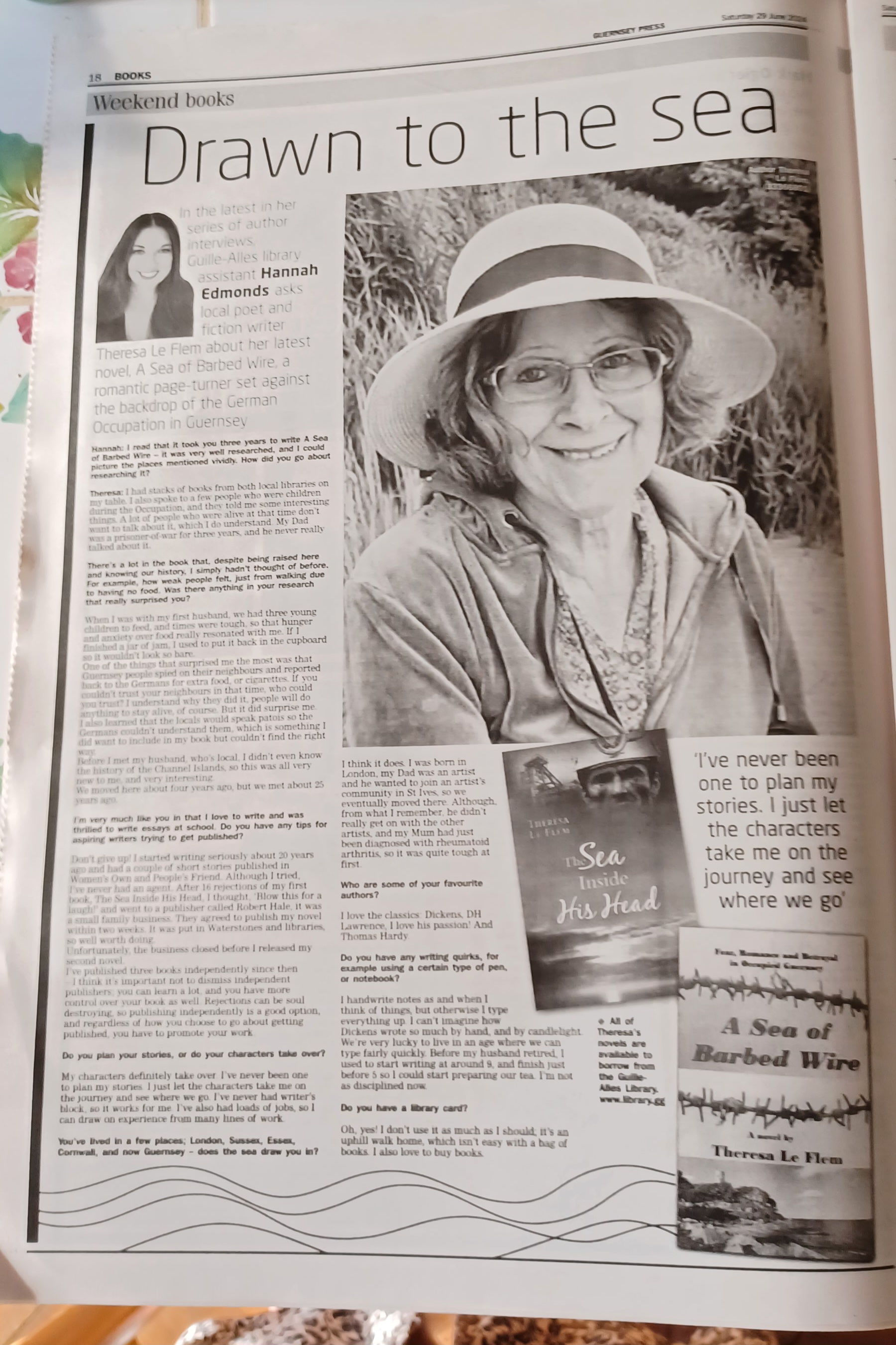
I’m delighted to see the interview I had with Guille-Alles Library Assistant Hannah Edmonds published in The Guernsey Press this morning, Saturday 29th June 2024. She was asking me about my latest novel, A Sea of Barbed Wire: Fear, Romance and Betrayal in Occupied Guernsey https://www.amazon.co.uk/Sea-Barbed-Wire-betrayal-Occupied/dp/B0CXP5Z2MX/ref= The research it entailed took me down paths I could never have imagined. The history of WW2 in the Channel Islands, the German Occupation and all that went on behind the scenes, was recorded meticulously yet secretly behind the backs of the Nazis. It’s a history which is little known about in the wider world. Their work, and many non-fiction books and personal diaries describing the events that took place in these islands, has provided me with years of reading and soul searching, and has inspired me to write this novel and maybe many more!
Below is a photo of myself in conversation with Keith Pengelly about my novel, A Sea of Barbed Wire: Fear, Romance and Betrayal in Occupied Guernsey. There were several authors, poets and musicians taking part and I was very pleased and proud to be invited. Keith told me he identified a lot with the characters in my novel, even to find similarities in some of their names with his own family. I enjoyed being able to talk about how Ellen and her parents in my novel risked their lives in helping and sheltering an escaped prisoner-of-war, a young Polish man called Lukasz. Also I described how they were coping with the food shortage, the strict and unreasonable laws, and the persecution the islanders underwent during the occupation. Keith is a local historian who broadcasts a fortnightly podcast on GNet Radio about Guernsey during the German Occupation https://island-fortress.com/ It’s well worth a listen.

A Sea of Barbed Wire: Fear, Romance and Betrayal in Occupied Guernsey is selling well at Guernsey’s new bookshop in the Arcade called ‘Writers Block’. https://writersblockgsy.com/
It’s also stocked in The Lexicon Bookshop, The Pollet, St. Peter Port
The other day I heard my novel has had a brilliant commendation from a founding member of the Channel Island Occupation Society. This makes all my work in research worthwhile; to have an expert in Guernsey history give it their approval just made my day!
I’ve just spotted this new brilliant 5 Star review for it on Amazon, yay! Thank you, “Lanky Lady”!
Here’s an extract of the review: “I was able to lose myself in the pages of this novel, especially as so many of the place names were familiar. The story centres around baker’s assistant Ellen and the injured escaped Polish prisoner Lukasz whom she and her family hide in their cramped attic. The fear of the family being caught by the German occupying force and the possible consequences almost leap out of the pages of this well-written novel and I was often on the edge of my seat. The research carried out by Ms Le Flem was exceptional though it helps that she actually lives on the island. Although the novel ends on a reasonably optimistic note, I can’t wait to read the promised follow-up novel. Thank you for taking me back to the most intriguing island of Guernsey!”
We authors are so grateful for reviews. To receive such feedback makes all the hours we spend slogging away at the computer feel worthwhile.
So well in fact that I’ve just had to take some more copies in as the proprietor Kelvin Whelan said he was “down to his last copy”! I’ve been delighted to hear from several people who have bought and read it already that they can’t wait for the sequel. I can’t wait to get on with writing it either but, guys, give me a break! I have so many chores to get done first before I can bury myself back in the past. Once I’m there, in the zone, not a lot else gets done! But even while I’m weeding the garden, the story is still unfolding inside my head. You can’s stop a writer thinking and dreaming.
Since writing A Sea of Barbed Wire my thoughts are still on the theme of war. It becomes impossible to watch the TV News these days without wondering how human beings can go on destroying each other even after the experiences of two world wars. .Yesterday I wandered round to Candie Gardens where an exhibition was taking place featuring the nursing staff and their work during the First World War. When an ex-soldier gave me a hand-grenade to hold I was amazed to suddenly come into contact with a weapon simply the size of my hand. A small, heavy and deadly thing, rusty and of course immobilized, but very real all the same. Then I took hold of and felt the weight of a soldier’s metal helmet. A helmet that had a jagged piece of shrapnel embedded in it; shrapnel that would undoubtedly have cost that soldier his life were it not for the helmet.
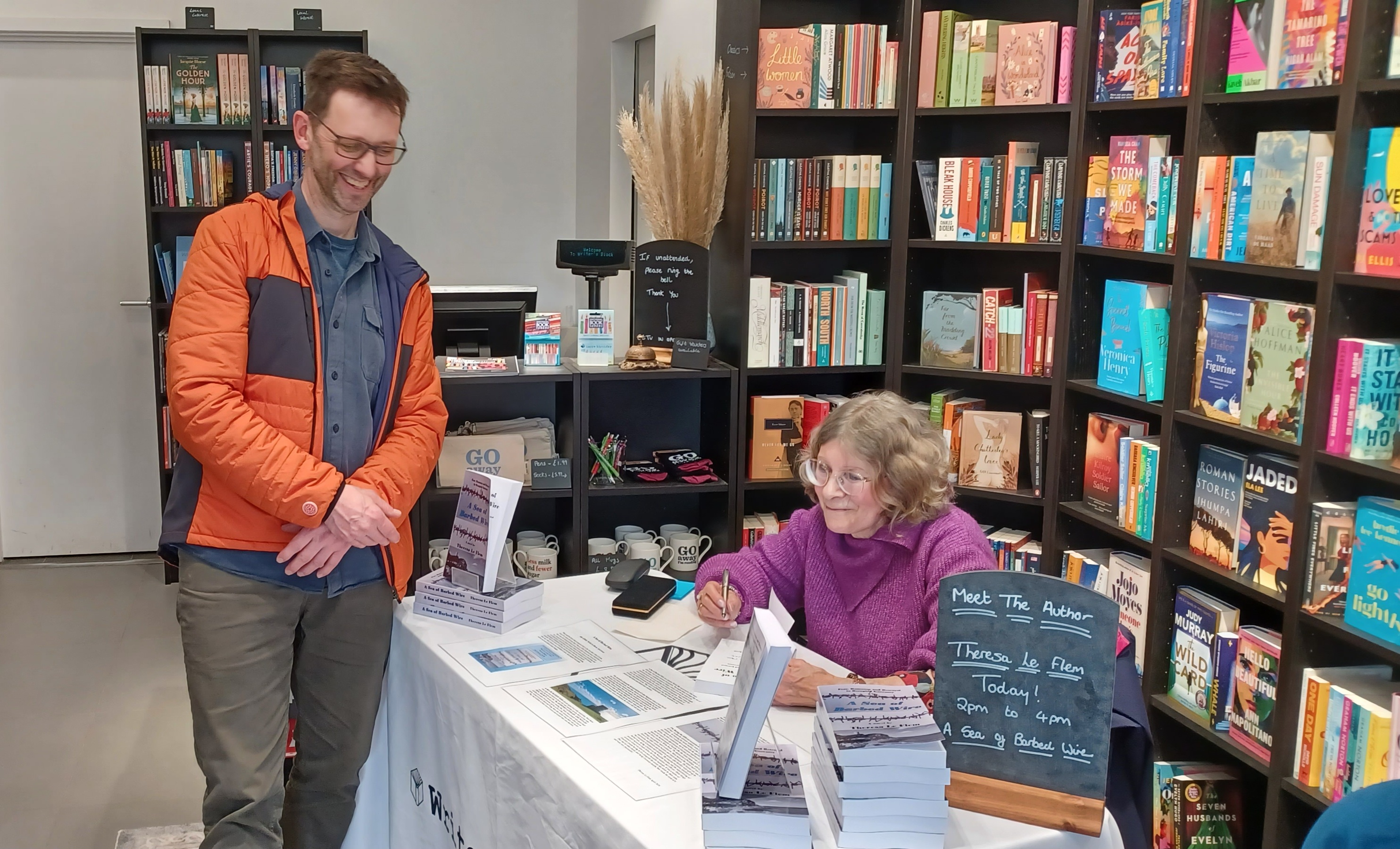
The sun shone, the people came and we were away! It turned out to be a sunny day too for my first book-signing in Guernsey. I was so pleased as people kept arriving and the bookshop, Writers Block, was buzzing! The subject of my novel has stirred some interest as the experience of this small island during the Second World War is unique, fascinating, and has a history sometimes reluctantly revisited by those who lived through it and endured much hardship. But it wasn’t all bad. There are happy memories too of that time. Perhaps it is this contrast between suffering and camaraderie which sparked the idea for my story.
This is a WW2 historical novel which tells of a time when the German advance across Europe didn’t stop at the French coast but ventured into the Channel Islands. History in these islands is fascinating and so within reach. Around nearly every corner there are reminders of the German occupation, fortifications along the coast which at that time was heavily guarded. Walk the streets of Guernsey and read about what happened during those days when islanders were forbidden to leave, local people lived under curfew and were almost always hungry. I look forward to meeting some of you there on Saturday.
“Ellen is defiant when a Polish prisoner-of-war who is fleeing from the Germans, knocks desperately on her door. Beaten and exhausted, Lukasz must be hidden, and fast. But defying the enemy is dangerous.
Plunged into a veil of secrecy where no-one can be trusted, Ellen’s nerve is tested when her friend Lucy becomes suspicious and demands to know what’s going on. Should she tell?
Torn between risking the lives of all who know her and her obsession with the troubled Lukasz, how far is Ellen willing to go in protecting a man she hardly knows?”
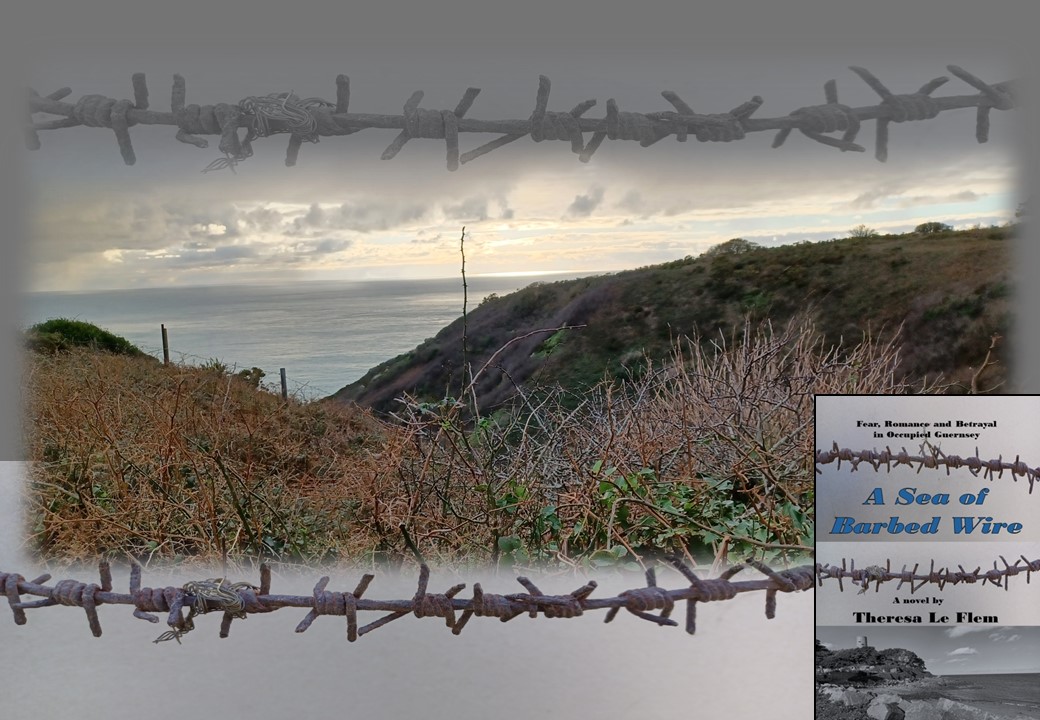
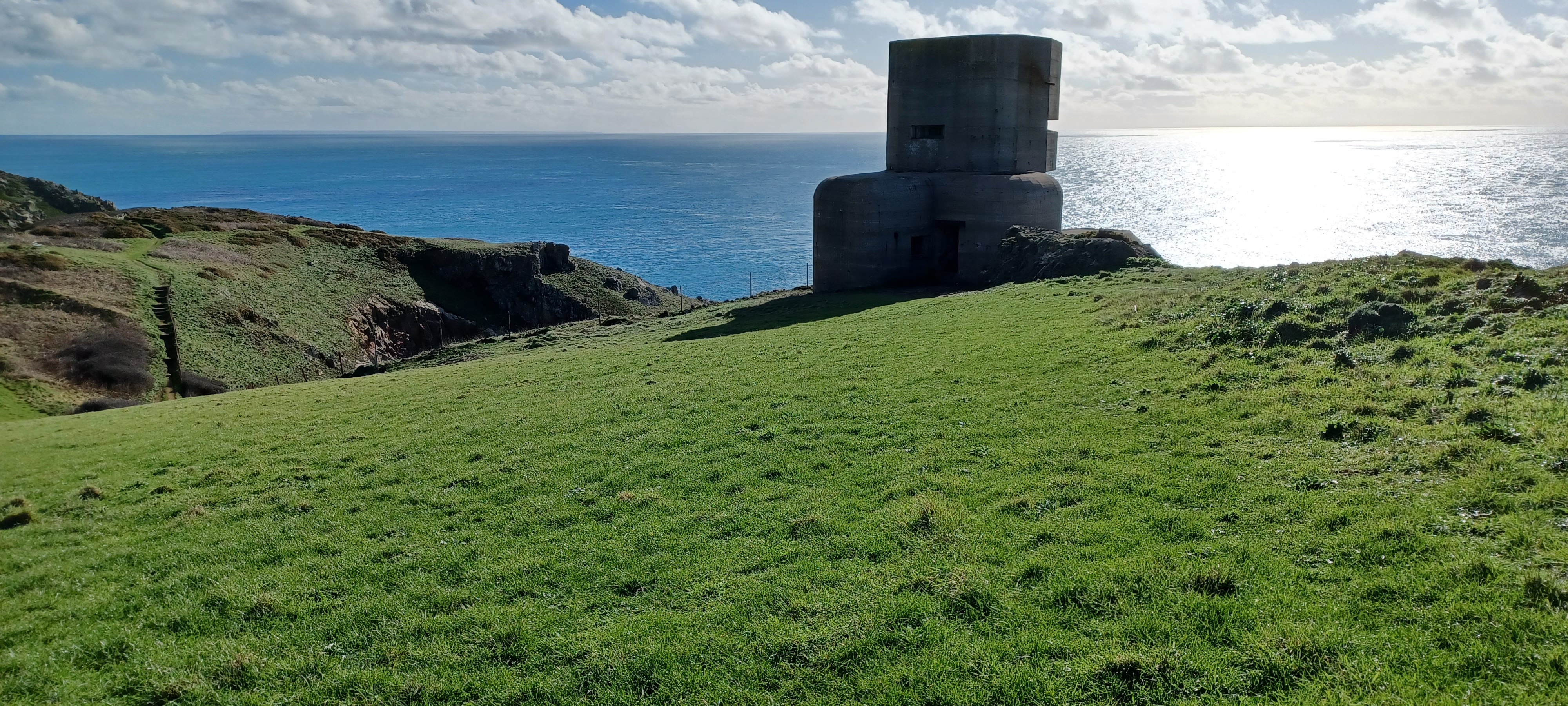
A Sea of Barbed Wire is a Second World War novel set in 1942 – when Guernsey was under German Occupation. You might think it strange that one of the first tasks I embarked upon to design a book cover for my soon to be published novel was to go looking for German bunkers! It was cold but bright with sunshine up on the hills where I took some photographs. When I got up close I could feel more than the cold wind; I could sense the stark reality of how the forced labourers must have suffered as they built these huge structures – it really came home to me. They were inadequately dressed, underfed to the point of starvation and denied any comfort.
I’m very excited to be bringing you this brand new novel which I’ve ben researching and writing for the last three years.
Set in Wartime Guernsey, 1942 during the German Occupation of the Channel Islands, the novel is a dramatic interpretation of what happens when a local family are faced with a dilemma when they find an escaped Polish prisoner on their doorstep who has been beaten cruelly by his captors and is pleading for their help. Concealing someone from the German occupiers is punishable by death. Ellen, a young woman of eighteen persuades her parents to have pity on the man and she wants to hide him but her father tries to send him away. What follows is a period of uncertainty for Ellen and her family when their circle of secrecy widens and eventually comes to threaten the lives of all who know them.
As I’ve mentioned before, I’ve started writing a sequel. I am over 40,000 words into the first draft. This new novel picks up the story five years later, taking us to 1947. Research for this is more tricky. So many people have told me, and written about, their experiences and memories of the German Occupation of the Channel Islands but funnily enough the immediate years after that are shrouded in vague recollections as life continued as much as was possible, as it had done before. I have spoken to some local people who were children of course during that time. Of those who were evacuated most returned and stayed but found they couldn’t settle and returned to the UK. Houses had been repaired, work and industry re-established, but the occupation had taken its toll. There were families destroyed by the pain of separation. Some relationships hadn’t survived and some were under a lot of strain because those who left either for their own safety or to fight for their country, weren’t the same people when they came back. Children left when they were small and returned taller and quite grown up. There was also a bit of ill-feeling against those who, it was rumoured, had helped the Germans, or worked for them, or stolen goods belonging to their friends and neighbours or looted the houses left during the evacuation. But gradually most of these things sorted themselves out and Guernsey life returned to the rural tomato growing routine it had known before.
A SEA OF BARBED WIRE should appeal to a wide readership, from those who enjoy love stories (Romance is always hovering under the surface) wartime novels, to those who enjoyed the book and film The GUERNSEY LITERARY AND POTATO PEEL SOCIETY. It should also appeal to those who are keen to learn more about the Channel Islands experiences during the war too. There’s a huge market here and curiosity among the tourists and visitors as well as locals for tales of the Germán Occupation.
My previous four novels, although set in the past 1960s – 80s , all reflect life during my own lifetime – which makes me sound very old! This one is history for real and I’ve had to do a lot more research because I couldn’t rely on my memory or imagination so much. I had to tie my own fictional family in with the events happening in Guernsey during that time. The novel opens in 1942, two years into the invasion. I wasn’t even born then! Some local people here, who spent their childhoods under Occupation, tell me a few of the Germans were often kind to them, rushed to protect them and bring them into shelter when there was an air-raid. They had children of their own of course and missed their own families. But those occasional acts of kindness were in stark contrast to the reality of war. Hunger, compulsory deportation, splitting up of families, and strict curfew regulations, with many other deprivations, all added up to five years of misery for most Guernsey people.
As the war in Ukraine continues, I can say that the military invasion of a country must be as terrifying today as it was back in 1940 when the Germans invaded Guernsey and the Channel Islands. I hope and pray Ukraine will be saved from what looks likely to be the continuing tragic loss of life, destruction of beautiful historic buildings and people’s homes and places of work. Thankfully Guernsey, although the harbour was bombed initially, wasn’t bombarded with missiles and bombs and wasn’t reduced to rubble. What the Germans did leave behind, the concrete bunkers and fortifications, still stand guard around the island, witnesses to the island’s traumatic past.
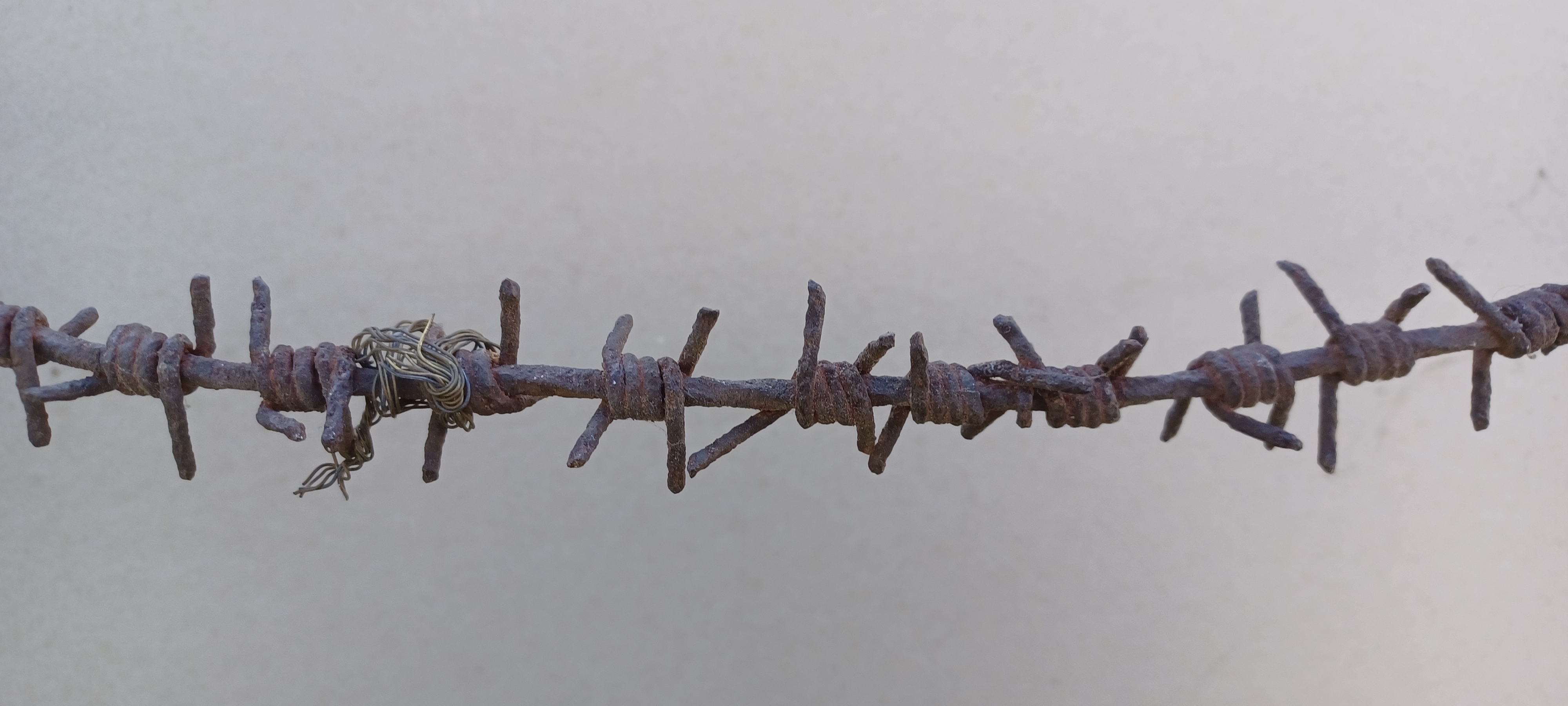
I’m finding the different accounts of islanders’ experiences vary, from not all bad – in that the German soldiers were on the whole quite kind to the children but also learning the more harsh realities of the occupation which are disturbing. I don’t know how I would have coped with the oppression, the meagre food rations, the cruel restrictions and punishments, not to mention imprisonment for minor offences, and of course deportation to German prison-of-war camps. But it was a quiet war. Guernsey was spared the bombardment of bombs (apart from the initial attack) and destruction of buildings; although some damage was caused it wasn’t extensive. More harm to the island itself was in the form of the many concrete bunkers and island defences. The human cost was in oppression, malnutrition and anxiety. The concrete structures, erection of barbed wire, laying of mines on the beautiful beaches, and the requisitioning of people’s homes to create billets for German soldiers and officers – these things created a virtually invisible war zone on a once beautiful landscape. Except for their initial attack, when bombs were dropped on the White Rock harbour devastating a line of lorries queuing up to load their crops of tomatoes onto the ships for export and killing drivers, growers, dock workers and passers by, it was a matter of Guernsey people having to live along side the enemy and abide by their rules.
T
 Theresa Le Flem